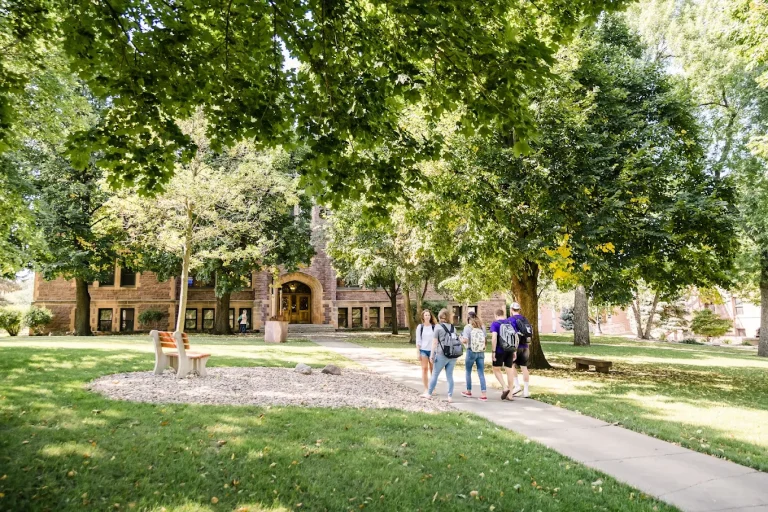
A Banking School Known for Excellence
The Graduate School of Banking is a 25-month, graduate-level executive education program held in Madison, Wisconsin. Designed to develop the leadership perspective banking demands, GSB brings together banking professionals from across the U.S. and beyond for three residential summer sessions.
Throughout the program, you will:
- Strengthen your leadership and decision-making with experienced banking leaders and industry experts who bring deep subject-matter expertise and real-world experience into the classroom
- Apply what you learn immediately through projects tailored to your own institution
- Lead a virtual bank in FiSim, the bank management simulation capstone that brings the full curriculum together
- Build lasting relationships with classmates, faculty and alumni who support you throughout your career
- Earn two credentials: a GSB diploma and an executive leadership certificate from the Wisconsin School of Business
Enroll today and join more than 23,000 financial professionals who have enriched their careers through GSB.


Where Banking Education Builds Lasting Connections
At the Graduate School of Banking, learning and connection go hand in hand. You will deepen your banking expertise across every major bank function, broaden your perspective with a curriculum that keeps pace with the industry, and strengthen your leadership and decision-making. Electives let you tailor your banking school experience to what matters most in your role. Just as important, you will build meaningful connections with bankers who face the same challenges you do, and those relationships grow with you long after the program ends.









Earn an Executive Leadership Certificate from the Wisconsin School of Business
You will leave GSB with more than a diploma. Through GSB’s partnership with the University of Wisconsin–Madison, one of the country’s leading public research universities, you will also earn a Certificate of Executive Leadership from the Wisconsin School of Business Center for Professional and Executive Development. Sponsored by 16 state bankers associations, GSB brings that university recognition to the bank leadership training you complete here, a combination that shows your institution you are ready for greater responsibility.

What You Will Gain at the Graduate School of Banking
Whether you are already in a leadership role or preparing for your next step, GSB is your professional growth partner. Every course is built around real-world application, so the concepts and tools you gain carry straight into your work at your bank.
Learn to anticipate regulatory and economic changes, adjust your bank’s strategy and manage risk before it affects your institution.
Build a working knowledge of how strong banks manage their finances, from asset/liability strategy and pricing to performance metrics and capital planning, so you can make decisions with a clearer view of how they affect your institution.
Develop the strategic thinking to help your bank compete in a changing market, from evaluating competitors and planning digital transformation to shaping marketing plans that support long-term growth.
Gain the confidence and authority to discuss financial information clearly and persuasively, whether you are speaking with your team, senior leaders or your bank’s board.
Bring the full curriculum together in FiSim, the bank management simulation capstone where you make executive decisions for a virtual bank and see their impact in real time.
Join a community of more than 23,000 GSB alumni, plus faculty and industry leaders, who share ideas, open doors and stay connected long after graduation.
If you are comparing banking schools, the value of GSB comes from how directly the learning connects to your work. You apply each lesson through projects at your own bank, learn from experienced banking leaders and industry experts and build relationships with peers across the country. For your bank, it is an investment in a strong internal leadership pipeline.

Our free guide gives you the talking points to show your institution how the GSB experience builds stronger leaders and delivers lasting value.
How the 25-Month GSB Program Works
At GSB, you spend your summers learning with classmates in Madison, apply what you learn at your bank throughout the year, and bring those experiences back to every residential session. Over 25 months, each step builds toward the FiSim capstone in your final year.




Whether you are strengthening your expertise in your current role or preparing for senior responsibilities, the GSB curriculum grows with you. Required courses cover every major area of banking, from lending and regulation to digital banking and shareholder value, with an emphasis on the trends shaping the industry today. See how the curriculum builds from year one through year three.
Our Banking School Curriculum
First-Year Required Courses
- Best Practices in Leadership Presentation Skills
- Digital Banking
- Economics, Money Markets and Banking
- Financial Management
- Leadership Beyond Management
- Loan Portfolio Management
- Marketing, Sales and the Customer Experience
- AI in Banking
- IT Strategic Management
Second-Year Required Courses
- Digital Banking
- Financial Management
- IT Strategic Management
- Loan Portfolio Management
- Marketing, Sales and the Customer Experience
- Strategic Leadership Issues
- AI in Banking
Third-Year Required Courses
- Enhancing Shareholder Value
- Interactive Ethics Workshop
- Leadership Lessons Learned
- Strategic M&A
- FiSim
Electives
In your second and third years, you will choose from a range of electives to tailor your studies to your role and the areas that matter most to your bank. Elective offerings are updated each year to reflect where the industry is heading.
- Business Growth & Development
- Mergers, Acquisitions & Financial Strategies
- Technology & Innovation in Banking
- Customer & Employee Experience
- Risk Management & Security
- Niche Lending
Graduate School of Banking Admission Requirements
Admission is by application only, and there is more than one way to qualify. Our banking school programs welcome bank officers, regulators and bankers ready for or already doing officer-level work. Review the three paths below to see which one fits you:
Note: In these requirements, “bank” includes FDIC-insured banks and savings institutions. The education and experience requirements in path 1 apply to all applicants except professionals who serve banks, who are considered case by case.
- Bank employees: Bank officers and bank employees doing officer-level work, with five years of banking experience plus either a four-year college degree or four additional years of financial services experience. Applicants with less experience will be considered when their application is accompanied by a recommendation letter from their CEO.
- Regulators and bank directors: State and federal financial regulators and bank directors who meet the same education and experience requirements.
- Professionals who serve banks: Professionals at fintech companies and other firms that provide services to banks, considered case by case depending on available space.
As a matter of policy, the Graduate School of Banking does not discriminate among applicants and participants on the basis of race, religion, sex, national origin, color, handicap, orientation or marital status.

Experience Madison, Wisconsin
Outside the classroom, discover what makes Madison special. Explore the lakes, stroll down State Street, visit the iconic Wisconsin State Capitol, or enjoy the city’s vibrant dining, arts, and entertainment scene. Whether you are visiting Madison for the first time or returning for another summer, there is always something new to discover.
Who Attends the Graduate School of Banking
GSB students come from community banks, regional institutions and large financial organizations, bringing a wide range of roles and experience to every class.
Most of our students are mid-career bankers. In a recent class, nearly two-thirds had 5 to 19 years of experience, and more than one-third came from banks with $100–500 million in assets.
Frequently Asked Questions
Tuition is $6,300 per session. An annual $350 registration fee is collected when you register in your first year and invoiced as a separate line item in years two and three. Tuition includes a single-occupancy room in a University of Wisconsin–Madison residence hall, daily breakfast, lunch and dinner, and instructional materials.
You will attend three 10-day residential sessions in Madison over the 25-month program. Between sessions, you will apply what you have learned by completing intersession projects at your bank and through a series of courses and assignments that you will complete at your own pace.
GSB is sponsored by 16 state bankers associations and offered in partnership with the University of Wisconsin–Madison and the Wisconsin School of Business.
Admission is by application only, and the enrollment deadline for the 2027 session is May 24, 2027. Your first annual $350 registration fee is due when you register.
Enroll early, arrive prepared. Applying early gives you more time to complete the self-paced coursework assigned before your residential session, so you arrive ready to make the most of your time on campus.
The annual $350 registration fee is non-refundable and non-transferable. If you cancel 15 to 60 days before the session starts, you receive a 90% refund of other fees, or 75% with 8 to 14 days’ notice. You can also keep other fees on account to use at any GSB school within 24 months.
Get a Head Start on Your MBA Through Our Partner Schools
Your Graduate School of Banking studies can help you earn an MBA sooner. GSB focuses entirely on banking, while an MBA covers business broadly. Qualified GSB graduates receive advanced standing in online MBA programs at the partner schools below, which reduces the time it takes to complete your degree.